


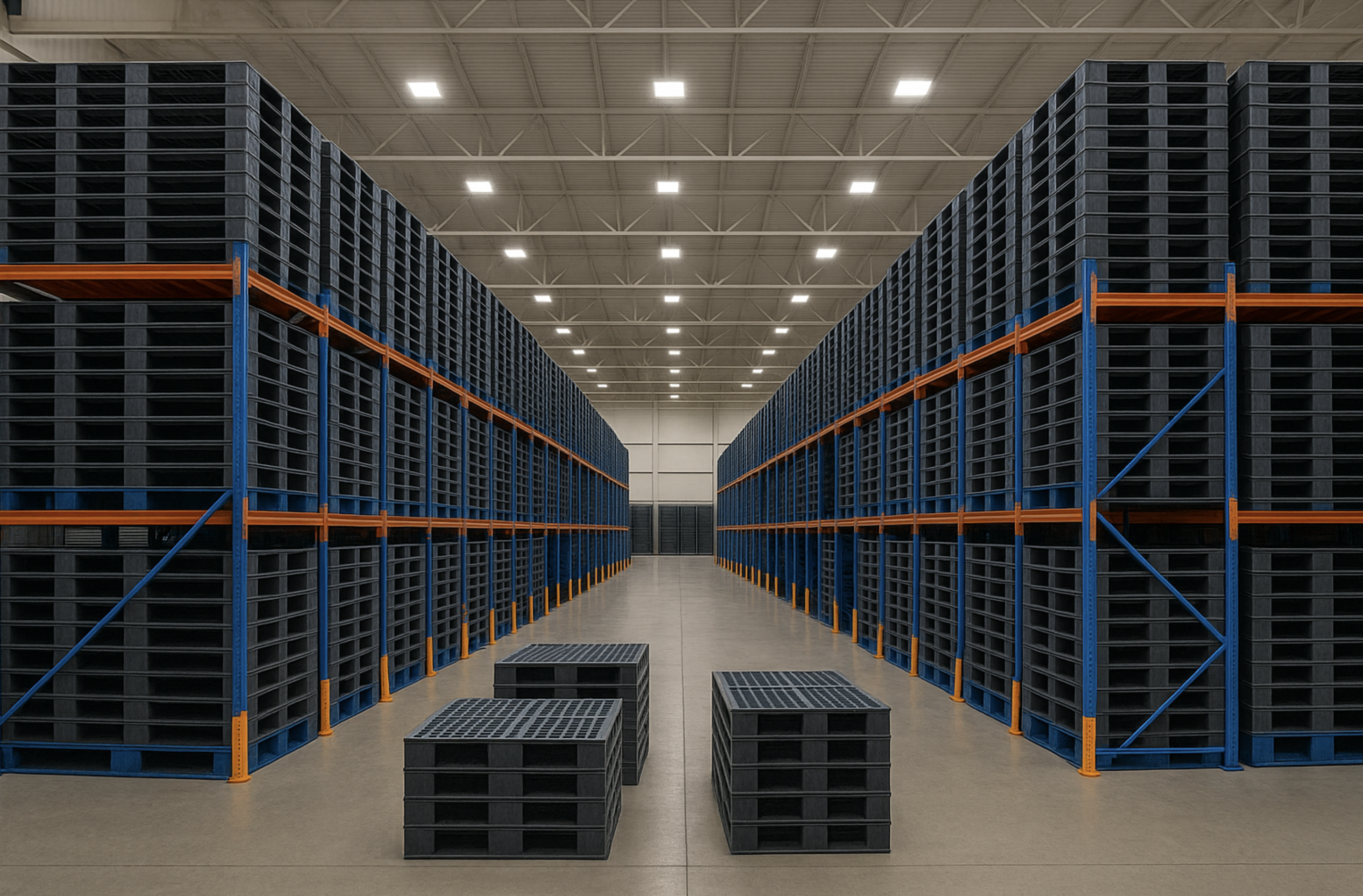
Why Plastic Pallets Are Better The Smarter, Cleaner, and More Sustainable Choice
Every business that moves products depends on pallets—they’re the unseen heroes of global logistics. But when you look closer at the materials used, a clear winner emerges. Today, sustainability, hygiene, and cost efficiency define competitive supply chains, and that’s exactly where plastic pallets rise above the rest. If you’re still using wood, it’s time to rethink what’s beneath your products.
Let’s break down the numbers and facts behind why plastic pallets are better—for your business, your budget, and the planet.


Sustainability: Where Responsibility Meets Profitability
Sustainability isn’t a buzzword anymore—it’s a metric by which companies are judged. In fact, a 2024 NielsenIQ survey found that 78% of consumers say sustainability influences their purchasing decisions, and nearly two-thirds of global CEOs list it as a top business priority.
Traditional wooden pallets rely heavily on lumber—a resource that’s becoming more expensive and ecologically sensitive. The U.S. Forest Service estimates that over 40% of all hardwood harvested in the U.S. is used for wood pallets. That’s billions of board feet of lumber each year—just to build something that may break within a few trips.
By contrast, plastic pallets are built to last—and be reborn. Most are made from recycled plastics like HDPE (High-Density Polyethylene) or PP (Polypropylene), and when they reach the end of their life cycle, they can be fully recycled again. A single plastic pallet can replace up to 100 wooden pallets during its lifespan, dramatically cutting waste and reducing deforestation.
That’s why major corporations like Amazon, Nestlé, and Unilever have integrated reusable plastic pallets into their sustainability initiatives. It’s a step toward a true circular economy where waste becomes a resource.
Cost-Per-Trip: Long-Term Savings You Can Measure
Let’s talk numbers—because sustainability alone isn’t enough. Businesses want savings, and plastic pallets deliver measurable ROI.
A wooden pallet might cost $12 to $15 upfront, while a standard plastic pallet could cost $25 to $40. But the difference lies in lifespan and performance:
- Wooden pallets typically last 5–10 trips before breaking or needing repair.
- Plastic pallets can last 150–250 trips, and in some controlled environments, even up to 500 trips.
That means the cost per trip for wood averages $1.50 to $2.00, while plastic pallets average $0.10 to $0.25 per trip over their lifetime.
On top of that, plastic pallets are 30% lighter than wood on average. That weight reduction cuts shipping costs—especially when products are shipped by air or in bulk. Lower fuel usage translates to lower emissions and a stronger sustainability report.
When you factor in reduced downtime, fewer damaged goods, and no repair costs, it becomes clear why plastic pallets are better from a financial perspective. Over time, the savings multiply exponentially.
Sanitation and Hygiene: A Safer, Cleaner Solution
If your business handles food, pharmaceuticals, or healthcare products, sanitation isn’t optional—it’s everything. Unfortunately, wood absorbs. It soaks up moisture, chemicals, and pathogens.
According to a study published in the Journal of Food Protection, 43% of wooden pallets used in food transport tested positive for bacteria like Listeria or E. coli.
Wood also harbors mold and can’t be easily sanitized. Even after fumigation or heat treatment, it can reabsorb contaminants.
Plastic, on the other hand, is non-porous and impermeable. Liquids, bacteria, and odors can’t penetrate the surface. Plastic pallets are better because they’re easy to wash, disinfect, and dry without warping or degrading.
Many are FDA-compliant and designed specifically for food and pharmaceutical environments. They also meet standards set by the U.S. Food and Drug Administration (FDA), which emphasizes the importance of non-absorbent, cleanable materials in food-contact surfaces.
Here’s the bottom line: if hygiene and compliance matter to your business, wood puts you at risk—plastic protects your product integrity.
Durability and Performance: Engineered to Last
Every time a wooden pallet breaks, it costs time, labor, and sometimes an entire shipment. Splintered boards and exposed nails damage products and injure workers.
The National Safety Council reports that pallet-related injuries cost U.S. businesses over $1 billion annually in lost time and compensation.
Plastic pallets eliminate those risks. They don’t splinter, crack, or rot. They maintain their shape under extreme temperatures and heavy loads. Some high-performance plastic pallets can handle up to 5,000 pounds static load and 3,000 pounds dynamic load—without bending or breaking.
Even better, plastic pallets are dimensionally consistent. That means fewer malfunctions in automated systems, fewer damaged products, and smoother logistics across warehouses and supply chains.
If your business relies on automation, robotics, or global shipping, uniformity matters—and that’s another reason why plastic pallets are better.
Why Plastic Pallets Are Better for International Shipping
Global shipping adds another layer of complexity. Wooden pallets require ISPM 15 compliance, meaning they must be heat-treated or fumigated to prevent pest infestations. Each treatment adds cost, documentation, and time.
Plastic pallets skip that entirely. They’re exempt from ISPM 15 because they contain no organic material—no pests, no fungus, no compliance headaches.
According to the International Plant Protection Convention (IPPC), non-compliant wooden pallets are among the top causes of shipping delays and customs rejections.
With plastic, your products move faster and smoother through global ports, saving both time and money. That’s why major exporters—especially in pharmaceuticals, electronics, and food—are converting to plastic across their entire logistics networks.
Eco-Impact: Less Waste, More Wins
Switching to plastic pallets drastically reduces your carbon footprint.
A study by the Fraunhofer Institute found that reusable plastic pallets emit up to 70% fewer greenhouse gases over their lifespan compared to wood.
Let’s put it into perspective: replacing 10,000 wooden pallets with plastic can save the equivalent of 400 trees and eliminate over 60,000 pounds of waste annually.
Because plastic pallets last longer and are recyclable, their overall environmental impact is lower—even accounting for manufacturing. When one reaches the end of its life, it’s melted down and remade—no waste, no landfill, no deforestation.
If your company reports sustainability metrics or ESG data, plastic pallets directly contribute to your waste reduction and carbon offset goals.
Worker Safety and Efficiency
Your workforce matters, and the right pallet system keeps them safer.
Wooden pallets are heavy and unpredictable—often weighing 50 to 70 pounds, sometimes with protruding nails or splinters.
Plastic pallets, on the other hand, typically weigh 25 to 35 pounds, with smooth edges and ergonomic designs that reduce lifting strain and injury risk.
OSHA identifies pallet handling injuries as a significant workplace hazard, which makes this improvement more than just convenient—it’s responsible.
Lightweight pallets also speed up warehouse efficiency. Workers can move more units per hour with less fatigue, reducing downtime and boosting productivity.
When you look at operational safety holistically, it’s yet another example of why plastic pallets are better.
Why Plastic Pallets Are Better for Your Brand and Reputation
Choosing plastic pallets sends a message—to your clients, partners, and employees—that your company is forward-thinking and environmentally responsible.
In an era when brand image is as valuable as product quality, this matters.
Companies that adopt sustainable logistics practices consistently outperform competitors in consumer trust. According to a 2023 McKinsey & Co. report, businesses with visible sustainability initiatives grow 2.5x faster than those that don’t.
Plastic pallets help you prove your commitment to the planet in a tangible, operational way. They’re a small change with a big impact that reinforces your corporate values and helps you stand out in a crowded market.
The Bottom Line: Why Plastic Pallets Are Better
When you add it all up, the choice is clear.
- Durability: Up to 10x longer lifespan than wood.
- Cost Savings: Cost per trip as low as $0.10 vs. $1.50 for wood.
- Hygiene: 100% non-porous, reducing bacterial contamination risk by over 90%.
- Sustainability: 100% recyclable and reusable.
- Safety: 30–50% lighter with zero splinters or nails.
- Compliance: No ISPM 15 treatment required for export.
Every statistic reinforces the same truth—plastic pallets are better in every measurable category. They’re not just a cleaner alternative; they’re a smarter investment in efficiency, sustainability, and brand strength.
Building a Smarter Future from the Ground Up
The question isn’t whether plastic pallets are better—it’s whether your business is ready to embrace the next generation of logistics.
From longer lifespan to lower cost per trip, from improved sanitation to reduced carbon emissions, plastic pallets deliver quantifiable benefits that align with modern values and global standards.
They’re an investment that pays off—financially, operationally, and ethically.
As industries evolve toward greener, leaner, and smarter supply chains, plastic pallets aren’t just keeping up—they’re leading the way. It’s time to make the switch and move your business forward, one pallet at a time.
